Visit our Website for more content: www.mmmrmag.com

Monday, October 29, 2018

Cannibals of Freedom: The Fight for Legalization & Expungement of Criminal Records - by Daniel Price, Esq.


As of October this year recreational use of marijuana was legal in Arkansas, California, Colorado, Maine, Massachusetts, Nevada, Oregon, Vermont, Washington, the District of Columbia, and the US commonwealth of Northern Mariana Islands.  On the November ballot in North Dakota, and Michigan are (perhaps now were) measures to legalize marijuana for recreational use, and Missouri and Utah for Medical use.

Here we are, the voters in Michigan have hopefully told the state that it’s time to honor freedom.
Freedom so far as the recreational use of marijuana is concerned anyway.  One very small step in the fight against government parasites who believe it moral to control your life, granting you privileges which replace and destroy your freedom, and who take your money and property while allowing you to keep only what they deem fit.

Yet, did Michigan get it right? The measure in North Dakota serves as a guidepost. In that state, the ballot proposal does not limit possession, nor does it include a regulatory scheme like Michigan’s. Think about that. The voters have kept the government parasites out of the picture. I see a major breakout of freedom in North Dakota that should be taking place here in Michigan.
 
But what about all those victims of the US War on Drugs (Freedom)?  What about the 643,000 arrested for marijuana crimes in 2015 alone?  What about the approximately 26% of all state and federal prisoners incarcerated for drugs?  What about those who suffered the loss of property, income, and in some cases their lives?  How will we ever be able to tell them, “sorry, too bad you got caught exercising freedom while it was banned?
 
What about the fact that while citizens were being denied freedom that causes no harm to the life, liberty or property of another, while government parasites who violate federal laws suffer no consequences?  For example, in November 1986 then President Ronald Reagan confirmed that the US illegally sold arms to Iran in exchange for the release of the US hostages in Iran.  It was later that former National Security Advisor John Poindexter admitted he personally authorized the diversion of some of the profits to aid the Nicaraguan "contra" rebels, even though Congress had prohibited such aid because of the Contra’s involvement in the cocaine trade.  Many people in government were indicted and found, or plead guilty, yet President G.H. Bush later issued pardons.  Only one private contractor actually did 2 years in prison, while none of the government parasites did any time.

What about when investigative reporter Gary Webb published his "Dark Alliance" series, which examined the origins of the crack cocaine trade in Los Angeles.  He claimed that members of the anti-communist Contra rebels in Nicaragua had played a major role in creating the trade, using cocaine profits to support their struggle. It also suggested that the Contras may have acted with the knowledge and protection of the Central Intelligence Agency (CIA).  You guessed it, the very same people involved in the Iran-Contra Affair.  Interestingly, Reagan’s vice president, G.H. Bush, was the CIA Director from 1976-77.

What about when Operation Fast and Furious which was uncovered in 2010 as a result of the murder of a US border patrol agent with a semi-automatic rifle that the Bureau of Alcohol, Tobacco, Firearms and Explosives (ATF) supplied Mexican drug smugglers.  Interestingly, the US’s chief law enforcement agent at the time, Attorney General Eric Holder, was held in contempt of Congress after he refused to divulge documents for a congressional investigation in to the matter.  Yet, in that same year Holder pledged to continue to uphold laws and prosecute marijuana cases in states where it becomes legal.  You know, “Bolshavick” means a group of related or linked statements or claims which are based on nonsense, or lies.

Consider government’s role in gun/drug running.  Also consider government parasites are rarely ever incarcerated for their crimes or treason to the principles of freedom.  While at the same time, a person who sells $50.00 of cannabis faces many years in prison and the loss of income and property, and suffers with a permanent criminal record.

The next step in Michigan needs to be a grass roots demand for the automatic expungement of all marijuana convictions and the return of all property and money to those previously convicted.  It is true, expungement of criminal records would never make up for the losses to those individuals.  Nor would it make up for the double standard of parasites who prosecute others for exercising freedom, while not themselves being prosecuted for destroying freedom.  But it would be a great second step in reclaiming freedom in Michigan.  We needed you in the fight to legalize marijuana.  We need you more in the fight to help right the wrongs of the past and expunge criminal convictions for marijuana offenses.  Let’s do this!

Till next month, as always, keep rolling on.

Disclaimer: This is an informational article only.  It is not to provide individual legal advice.  If you need legal services, feel free to contact me, or any attorney of your choosing.

Free the Weed 93 - by John Sinclair


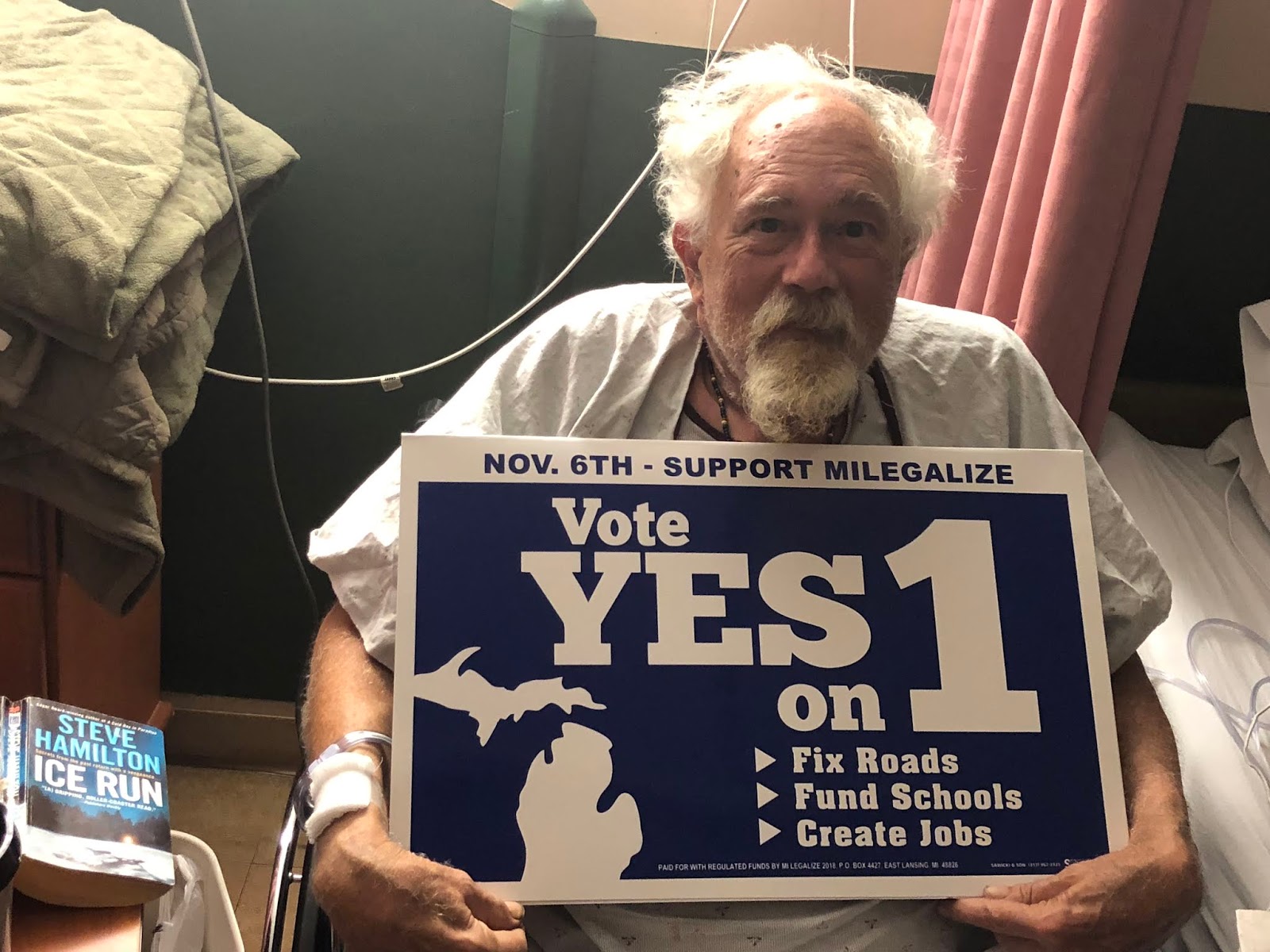
Interview conducted with John Sinclair at a rehab center in Detroit. John was recovering from a fall on October 10th, 2018 and was unable to finish his monthly column, so Jerome Poyton, Kira Horner and myself, Ben Horner, made a visit to make sure the column continued uninterrupted after seven years in the MMM Report.

Q. How do you feel about Prop One? 

A. I don’t like it very much, but I hope it passes because it’s a step forward. It’s a flim flam, I felt like these guys came in on a white horse to they were going to make up for the incompetence of Michigan Legalize. But as soon they handed into the petitions they changed the name to Regulate Marijuana like Alcohol. That very cheesed me off. That’s the last thing in the world I want. The clear line you draw from marijuana and alcohol, the closer you are to the truth.  Marijuana has nothing to do with alcohol. The other thing is MMP was corrupt and pussy grabbing, and now they have no money to finish the campaign. This is just my personal belief, as the guy that started legalization in Michigan my thoughts carry a curtain weight.

Q. How long have you been working on Legalizing Cannabis? 

A. Since January 1965, when I started Lemar. I got a flier in the mail from Edward Sanders and Allen Ginsberg in New York. It said, “Legalize Marijuana, Lemar!” So I thought what a great idea, so I started the Detroit Chapter. I typed up a flyer and ran off some flyers on the mammographic machine. We held the first meeting of Lemar in Detroit. We had no organization, we had no idea what we where doing, but it was a great idea.

Norml grew out of organization called Amorphia, Blair Newman and my dear friend Dr. Michal Aldrich aka Dr. Dope. Aldrich got his PhD from New York University, and started the first marijuana publication. Some how he stumbled on the Detroit Artist Workshop and me. Blair Newman new how to organize shit, and the two of them for Amorphia and their slogan was “Free Legal marijuana in your Backyard.” Their brilliance and downfall where in the same bag, because they wanted to create a marijuana orientated  product which they could sell to finance the political struggled to legalize. They form Acapulco gold rolling papers. Aldrich and me where tight. They organized the first California legalization initiative and I was invited out to speak. It was then that I met Keith Stroop, when he was starting Norml. Which we thought was square., because who wants to be normal.

Amorphia had it in their mind to develop a hemp paper, and they spent about three years working in Spain, which was they only people developing rolling papers at the time. Well by the time they had, all the money was gone. The first shipment was came, hundreds of boxes of papers, to a bonded warehouse in San Francisco. They couldn’t get them out because they had no money, so they went down and turned everything over to Keith Stroop and Norml.

From there I got in with Keith and barnstormed around California, Arizona and New Mexico, speaking and advocating. In those days this was really far out, because nobody did this. The only other person doing this sort of thing Gingsberg, Aldrich, Sanders and me was a lawyer in California. He developed a legal brief that became a guiding document for me and many others.

That flier I got from Ginsberg was the beginning. It was for a demonstration in New York.

Allen Ginsberg holding a sign that reads: “Pot is a Reality Kick”. Maybe from Dec. 27, 1964.


Q. What about Canada?

A. It makes me feel good, because in those days Canada was like 50 years behind. You now Canada bared me, from entry into their country because of a marijuana conviction.  I hate Canada. In 1974 we made the terrific mistake of responding to the City of Ann Arbor banning the Ann Arbor Blues and Jazz festival after two years. We got an offer from St. Clair College in Windsor to do it there, and like idiots we accepted. That ended that period of organization, because the RCMP. I was banned from my own concert. They where walking out into the crowd in the amphitheater arresting people. The RCMP where backstage, harassing BB King, Cecile Taylor and the rest of the artists.

Q. What’s next? 

A. I’m taking it one step at a time. I have no faith in anything after that last election. They are maniacs. I thought we where going to have Hilary, but know we have these clowns.

Q. How do you vote?

A. Right now I’m not walking yet. If I can be there on November 6th, I would like to vote in person. But I will probably cast an absentee voting. There is no irony in that. Voting is voting and I always vote.


So What's In It For Me? - by Tim Beck

Tim Beck: Chairman of the
Safer Michigan Coalition
The deadline for this column is October 22, and MMM Report will go to print shortly thereafter. It will hit the stands before the election on November 6, where the fate of cannabis legalization in Michigan will be decided by the voters.

While it is likely the measure will win, I'm superstitious about about proclaiming victory and speculating about good or bad things before the results come in. So during this brief, twilight space, I thought some readers may be interested in how this legalization movement got started many years ago and what I had to do with it.

 In the 1960's and early 70's, my fellow MMM Report columnist John Sinclair was Michigan's foremost marijuana legalization activist. Among other things, John endured hard time in Jackson Prison for marijuana possession. He inspired a movement which ratcheted down draconian punishment under state law for cannabis use. Ann Arbor, his home base, reduced marijuana possession to a $5 fine. Lot's of people realized the value of the herb because of John's work.

However, as the 1980's began and the Ronald Reagan era took hold, cannabis policy activism which resulted in immediate political change, went dormant in Michigan. A  new war on marijuana was declared by the US Government.

As someone who always liked herb since I took my first toke in a dorm room at the University of Detroit in 1970, where I later graduated magna cum laude and was elected student body president; this new era of government oppression was distressing. However, I felt helpless to do anything about it. I simply laid low, and focused on succeeding in the corporate health insurance business.

 At that time, I was sales manager for a local Health Maintenance Organization (HMO) and my greatest sale was Detroit Edison. In 1988, I started my own company, "Michigan Benefit Providers Inc," which specialized in HMO sales and services to the business market. By the mid 1990's the company was so successful, I had the time, money and personal freedom to get back into the political arena.

Identifying with the libertarian wing of the Republican Party, I ran for State Representative in the GOP primary in Grosse Pointe in 1996, but did not win. I then became editor of the local  party newsletter for three years. When a new local board came to power, it was time find something else to do.

Intrigued by the success of medical marijuana in California, and hating cannabis prohibition; I studied the situation and decided to do a ballot initiative in the City of Detroit, to legalize medical marijuana under the city code.

An organization called the "Detroit Coalition for Compassionate Care" (DCCC) was created. I  was the only member and financier. Due to poor legal advice, we failed to make the ballot in 2002, but came back again in 2004. This time we won in the August city wide election with 59% of the vote. Grassroots politics expert Neal Bush served as campaign manager and State Representative Lamar Lemmons  played a key role in securing the signatures needed to make the ballot. Libertarian political consultant Tim O'Brien handled direct mail and imaging.

When the campaign began, my family got a brick through our window the day the opposition press release went out.

DCCC was condemned by Governor Jennifer Granholm, Attorney General Mike Cox, Mayor Kwame Kilpatrick, Oakland County Sheriff Mike Bouchard, Macomb County Prosecutor Eric Smith, the Detroit News, the Detroit Free Press, the Michigan State Police, the federal "Drug Enforcement Agency" the "Partnership for a Drug Free Detroit" and various members of the  clergy.

Coincidentally that summer, Chuck Ream started his own medical marijuana ballot initiative in Ann Arbor independent of DCCC.  Ann Arbor won by an overwhelming margin that November.

With Detroit and Ann Arbor weighing in, new hope was given to those who wanted change.

I was elected  Executive Director of Michigan NORML by the membership and Chuck and I mentored successful ballot measures in Ferndale, Traverse City and Flint. Recognizing success, the Washington DC based "Marijuana Policy Project" (MPP), funded by billionaire insurance entrepreneur Peter Lewis, stepped up with $1.5 million and funded a ballot initiative which legalized medical marijuana state wide in 2008.

In 2009, Chuck and I formed the "Safer Michigan Coalition" with the goal of legalizing adult use of marijuana for any reason.  We created a state wide list serv for mature activists who wanted real policy change. Over the years we mentored local leaders both Individually and collectively; to use the ballot initiative process to legalize recreational marijuana in cities such as Detroit, Lansing, Flint, Jackson, Kalamazoo, Port Huron, Mt. Pleasant, Oak Park, Ferndale,  Berkley, Hazel Park and Pleasant Ridge.

In an independent effort, Michael Tuffelmire, Jack Hoffman and others legalized the herb in Grand Rapids.

Robin Schneider and the "National Patients Rights Association" worked with the Legislature to set up a medical marijuana provisioning system. They succeeded in 2016.

All of these efforts bore fruit again. In 2018, with assistance from MPP and a Michigan organization called MI Legalize, the voters will be weighing in on statewide legalization this November.

So why me?

Well, I believe my family and the local community I grew up in had lots to do with it.

I am the oldest of 8 children from rural Monroe County, Michigan. My dad worked in factories in Toledo and Monroe. My mom was a homemaker. They did the best they could with the limited tools they had. The community was isolated from the outside world and I was a non conformist. I developed a contempt for authority figures, bullies, hypocrites and the pathologically stupid. My goal back then, was to simply pull the rip cord and get out of there as soon possible. I got a full scholarship from the University of Detroit in 1970, and never returned to Monroe County.

To this day, I dislike most cops, prosecutors, clergy persons and hypocritical politicians. Fighting to legalize weed is a big middle finger to the worst of this lot.

Out of altruism and self interest, I've spent countless hours of my life and over $200,000 out of my own pocket on ballot initiatives, legal fees and donations to various politicians to put an end to cannabis prohibition.

 Prohibition for peaceful, consenting adults is intrinsically flawed. It is a waste of public resources. It has victimized thousands of decent persons for no good reason. My altruistic goal from day one, was to tear down this rotten edifice.

As for self interest, I love politics. Some people I know spend $200K on a boat. They like boating as much as I like being a political player and the subject of media attention. This issue has paid dividends over and over for many years.

At his stage of life, it is a great joy to see a new generation taking the reigns. Mainstream political power brokers, corporate interests and major candidates for Michigan Governor and Attorney General like Gretchen Whitmer and Dana Nessel  are are also stepping up.

Even President Donald Trump has been saying the right things from time to time.

It's all good.

Tim Beck and Family

World News for November 2018 - by Megan Smith

No Mary Jane for Mounties?

Canada- The RCMP recently announced that mounties will be banned from smoking marijuana within 28 days of any shift. Officials stated that there were concerns regarding how long cannabis effects would last, as well as concerns regarding the possibility of a Mountie testing positive for marijuana after being involved in an accident or shooting. This policy comes in direct opposition to the policy recently released by the Canadian Armed Forces, which only restricted cannabis use within 8 hours of any active shift, or 24 hours for any personnel performing duties requiring the use of any heavy machinery or firearms.

Many police departments, such as Ottawa, Vancouver, and Saskatoon, have adopted similar policies, stating that as long as officers are ‘fit for duty’ when reporting to their shifts, officers will be permitted to use cannabis while off duty. However in contrast, Calgary Police Department has stated that they will uphold a ‘zero tolerance’ policy regarding Cannabis for officers, and Toronto Police have been said to be considering adopting the 28 day ban as well, however nothing definitive has been released as of yet.

_______________________________________________________________

Specialists Finally Given Cannabis Prescribing Rights

United Kingdom- Specialist Doctors in the UK have finally been given the option to prescribe cannabis based medications to patients that they feel will benefit from its medicinal properties, this new law will not limit what conditions that will be considered. While general practitioners will not be permitted to prescribe cannabis, specialized  Doctors in fields such as Neurology or Pediatrics, that are listed on the General Medical Council specialist register will be permitted to do so, without the need of an expert panel to review each individual case.

The new law will go into effect as of November 1st of this year. Home Secretary Sajid Javid was quoted as saying “Having been moved by heartbreaking cases involving sick children, it was important to me that we took swift action to help those who can benefit from medicinal cannabis. We have now delivered on our promise and specialist doctors will have the option to prescribe these products where there is a real need. I’m grateful to the expert panel – who have been considering cases in the interim – and to those who’ve worked hard to bring about this change at the earliest possible opportunity.”

_______________________________________________________________

Military to Surrender Marijuana Monopoly

Italy- Italian citizens have had medicinal cannabis laws in place since 2013. However, most patients were not able to obtain their medication until a formal system was set into motion in 2017, at which time there were approximately 300 patient applicants. That number jumped to approximately 10,000 patient applicants in 2018, and as a result the Italian government has been struggling to keep up with the patient demand.

Previously the Military Chemical and Pharmaceutical Plant (SCFM) were the soul providers of medicinal cannabis for the entire country. To address this supply and demand gap, the Italian government has recently issued seven medical cannabis import licenses, most of which are being controlled by Canadian joint ventures. For example, a Toronto based company, Nuuvera which has acquired Genoa based FL-Group, which happens to hold one of these licenses, as well as Pedanios, a German subsidiary of Aurora Cannabis, which has won an exclusive contract to supply 100 kg of medical cannabis to the Italian Government.

 _______________________________________________________________

Capital Punishment on Cannabis; Under Review

Malaysia- Muhammad Lukeman Mohamad was given the death sentence for selling medicinal cannabis oil to cancer patients in August, which resulted in a public outrage, of which even the new Prime minister Mahathir Mohamad took a stand against. The Malaysian government responded by repealing the sentence against Muhammad, as well as announced that they will be eliminating the death penalty all together.

Government officials stated that preparations are under way to rescind the Sedition Act as well, which was previously used to silence critics or opposing politicians. The rescinding of both of these laws, have resulted in the repeal of death sentences for over 1,200 people, many of which were sentenced to death due to drug crimes. In a region where capital punishment for drug related crimes is quite prevalent, Malaysia would be only the 3rd country in Southeast Asia, to eliminate capital punishment, joining Cambodia, and the Philippines.

_______________________________________________________________

Standing Strong Against Marijuana

Singapore- The Singapore Government has stated that they intend to remain firm in their position against decriminalizing and/or legalizing medical cannabis, staying that any review of their position on Cannabis must be “based on scientific evidence”. While referencing a recent publication from the Institute of Mental Health, claiming that cannabis is addictive and harmful to the developing brain, a spokesperson for the Ministry of Home Affairs stated;

 “On the other hand, evidence of cannabis’ long-term safety and efficacy is scarce. These findings corroborate our position that cannabis should remain an illicit drug. Even if cannabinoid pharmaceuticals have to be used for medical purposes, there are carefully established frameworks in Singapore for their clinical prescription.”

These comments come in response to the recent public outrage that ultimately led to the repeal of the death penalty sentence for Muhammad Lukeman Mohamad, for selling Cannabis oil to cancer patients, in neighboring Malaysia.

_______________________________________________________________

Landslide Win for Medical Marijuana

Lithuania- Lithuania is set to join multiple other European countries including Austria, Britain, Croatia, Finland, France, Germany, Greece and Italy by passing medicinal cannabis in a landslide vote of 90-0. The bill is now set to be signed into law by the president, Dalia Grybauskaite. Lawmaker Mykolas Majauskas, who tabled the bill stated “It is a historic decision to ensure that patients can receive the best possible treatment, of course, it does not mean cannabis will be available to get at a drugstore to smoke before going to a nightclub,”. While recreational Cannabis use will still be illegal, the law is set to take effect in May of 2019.

_______________________________________________________________

Crack Open an Ice Cold CBD Coca Cola

Canada- The recreational marijuana law that has gone into effect as of October 17th has significantly spiked the Canadian Cannabis business market, inspiring many high profile companies to express interest in joint ventures. A multitude of business opportunities have recently opened following the new law. Such as, Canadian based company Coors whom recently announced that they will be partnering with Canadian Cannabis producer Hydropothecary in developing a non alcoholic beverage containing Cannabis. Similarly, Constellation Brands, the maker of Corona also recently announced that they intend to invest $3.8 billion in Canadian Cannabis producer Canopy Growth.

A few American based companies have even announced their interest in joining this booming Cannabis market as well. American based beverage company Coca Cola, has stated that they are considering releasing a version of their soda containing CBD, the non psychoactive ingredient of Cannabis, as to target consumers that are looking to ease inflammation and related pain. Tobacco company Alteria Group, the maker of Marlboro is also reported to  be in talks regarding a possible investment venture with Cannabis producer Aphria, though no formal agreements have yet to be announced.


National News for November 2018 - by Kathy Hess

Gubernatorial & AG Candidates Arrested with 48 pounds of Cannabis

RHODE ISLAND- Alan Gordon, 48, and Anne Armstrong, 58, - who are running for Rhode Island attorney general and governor, respectively -  were arrested for having 48 pounds of illegal marijuana in the duo's West Greenwich home, RI police said.

 “On way to the Wickford barracks under arrest for cannabis again,” Armstrong tweeted Thursday morning from what appeared to be the back of a police cruiser. “I guess our poll numbers were high enough to scare them into committing an atrocity. Pray for our police.”

Officials said they searched the pair’s home after receiving a complaint of a “strong odor of marijuana emanating from marijuana plants being illegally grown outdoors.”

Rhode Island state police said they found at least five large aluminum trays full of pot.  They also found marijuana “growing outdoors and in plain sight” without the state-issued tags required for growing medical marijuana.

Police said they also found trays holding drying marijuana. 

A 15-year-old child was inside the home at the time of the arrests, police said.

The pair, who are leaders of a Christian sect – The Healing Church – that uses marijuana for religious services, appeared in court Thursday afternoon. They did not enter pleas on charges of marijuana possession and contributing to the delinquency of a minor.

They were ordered held on $25,000 bail.

According to the Providence Journal, the pair’s stance on marijuana has sparked previous run-ins with police. In one lawsuit filed against the state, Armstrong and Gordon claim the enforcement of state marijuana laws against them amounts to religious discrimination and violates the U.S. Constitution.

They also argue the term “marijuana” is racist and prefer the word “cannabis.”

_______________________________________________________________

Confidence in Medical Marijuana Initiative is Fading

UTAH-- With less than a month until the election, recent polls show that support has faded for Utah’s medical marijuana ballot measure, particularly among members of the Church of Latter-day Saints. Many attribute the change to a pledge made by the governor and cannabis advocates to push through a legislative compromise regardless of voters’ conclusion on Prop 2.

The Hinckley Institute of Politics poll suggests that slightly above 50 percent of Utah voters now support the ballot measure, a 15 percent dip from a similar survey conducted in June. Though 35 percent of the most recent poll’s respondents still indicated that they are strongly in favor of Prop 2, a full 46 percent said they were in opposition and only three percent stated that they had yet to form an opinion.

Members of the Church of Latter-day Saints showed a dramatic decrease in support for the measure. Among those who identified as very active in the church community, the percentage of individuals who said they were strongly in favor dipped from 25 to 11 percent between June and October. The drop is unlikely to be due to their church’s opposition, which has been constant throughout the ballot measure campaign. 55 percent of active members stated in the survey that the church’s position made no difference in how they personally planned on voting.

Hinckley Institute director Jason Perry stated that fading support is most likely due to Governor Gary Herbert’s recent announcement, which had to do with an agreement with state leaders and marijuana advocates that a special legislative session will be held next month. The session, Herbert says, will come up with a separate plan for Utah medical marijuana that would involve a state-run distribution system or a limited number of “cannabis pharmacies.” Opponents have taken Prop 2 to task for its “Wild West format,” expressing concern that it does not guard against black market sales, and surmising that the plan would lay the groundwork for recreational marijuana in the state.

The tentative agreement hyped by the governor would axe timeline guarantees from the ballot measure. It also promises to expand access in certain regards, allowing patients without easy access to a dispensary to grow their own weed and giving non-card holders who meet certain criteria a legal defense should they be faced with drug charges.

_______________________________________________________________

Dispensaries a GO to Post Price Info

NEW JERSEY--Medical marijuana patients can now shop products and know how much it’s going to cost due to new changes in the state program’s policies around price transparency. New Jersey’s six operating medical marijuana facilities can now publicly post their product prices on their websites and social media after state officials said that patients in the program should be armed with more information when making purchases.

Listing product prices is an option, but not a requirement, and dispensaries can chose what, if any, price information to post on their websites, state officials said.

Since the announcement last week, Breakwater Treatment and Wellness in Cranbury, Curaleaf in Bellmawr and Harmony Foundation in Secaucus have listed prices for different amounts and strains along with their daily menus.

For a quarter ounce of flower bud, prices range from $85- $120, according to the N.J. centers’ websites and posts on Facebook pages.

Assistant Health Commissioner Jeff Brown, who oversees the state’s Division of Medicinal Marijuana, said the price transparency puts New Jersey patients and dispensaries on par with program participants in Pennsylvania and Washington, D.C. There are about 33,200 participating patients in the state’s medical marijuana program, according to the state Department of Health.

Of the 16,000 new patients who have joined since January, health officials said a majority have at least one of the five medical conditions added in March, which include anxiety, migraines, Tourette’s syndrome, chronic pain related to musculoskeletal disorders and chronic visceral pain.

In addition to adding more medical conditions, state officials earlier this year made reforms to the medical marijuana program by adding mobile access, opening the doors to satellite locations, making changes to requirements for physicians and reducing program fees.

South Jersey participants have said that while they champion the growth of the state program, the costs of participation still remain high. At the price rates listed by several treatment centers, it would cost between $680 and $960 to buy the maximum purchase amount of two ounces per 30 days.

_______________________________________________________________

2 Arrested; Trafficking over 100lbs of Pot

IDAHO FALLS — Idaho State Police say two people were arrested after officers discovered more than 100 pounds of marijuana during a traffic stop near Idaho Falls.

KIFI-TV reports police arrested 25-year-old Javier Luna-Gutierrez and 19-year-old Aida Rodriguez-Hernandez following the stop Sunday on U.S. Highway 20.

Police say a small amount of methamphetamine was also found.

Luna-Gutierrez was arrested on suspicion of trafficking marijuana and possession of methamphetamine.

Rodriguez-Hernandez was arrested on suspicion of trafficking marijuana.

Both are residents of Visalia, California, and they were booked into the Bonneville County Jail.
The U.S. Department of Homeland Security has filed an immigration detainer on both.

It wasn’t immediately known if either had obtained lawyers.


Michigan News for November 2018 - by MMMR Staff

Whitmer Leads Schuette Everywhere Except North MI

LANSING- Gretchen Whitmer’s lead over Bill Schuette is at 50 percent to 36 percent in the race for governor, according to a poll released by Marketing Resource Group (MRG).

Whitmer leads Schuette in every geographical area of the state except for northern Michigan, where he’s up 45 percent to 41 percent, according to the press release and data released by MRG.

The Democrat leads the Republican by 12 percentage points (50 percent to 38 percent) in generally Republican West Michigan.

The former Senate Minority Leader leads by 23 percentage points with women voters (55 percent to 32 percent) and by 21 percentage points with Independent voters (37 percent to 16 percent).

Schuette has 46 percent of voters carrying a negative perception of him, while 26 percent of voters have a negative perception of Whitmer. She’s favored positively by 39 percent, and Schuette has a positive perception among 24 percent.

MRG President Tom SHIELDS attributed Schuette’s favorability to his “bitter primary battle,” and said Whitmer “has put together an impressive coalition of metro Detroit and West Michigan voters, women and young voters that Schuette has not been able to crack.”

The poll, not paid for or sponsored by any outside third parties, consisted of 600 likely Michigan voters contacted via live interviews from Oct. 14 to Oct. 18, with 30 percent of the sample coming from cell phone users. The margin of error was 4 percent.

To date, both candidates state they are in favor of Prop 1, however Nessel has always been a supporter of marijuana rights, where Schuette has only recently caved to popular support.

________________________________________________________________________

Half a Mill in Drug Money Seized

DETROIT - Nearly half a million dollars in drug money is off the street thanks to the Detroit Police Department.

The raid happened at a check cashing place and a small business next door at the intersection of Connor and East Warren. Police say they’ve been watching these establishments for quite some time.

“They were operating selling marijuana as if this was already a recreational state,” said Lt. Jonathan Parnell with Detroit police.

“We already knew that the location was not licensed,” Parnell said. “It’s not licensed through LARA with the state of Michigan. There’s no application, it was just a nondescript building.”

“Conducted surveillance on this location and actually carried out two undercover buys from this location,” Parnell said. “We were able to develop probable cause where we were able to execute a search warrant here next door and as well as both of the suspects’ residences.”

Hundreds of thousands of dollars worth of drug money was confiscated. The amount of cash found at the business was more than $150,000. At the owners home, another $240,000.

“They were rather surprised, but they were taken into custody without incident,” Parnell said.

Two men in their 30s were arrested and are now facing possession with intent to deliver narcotics charges. Also, it wasn’t just marijuana police found during the raid that has them concerned.

“Preliminarily, one of those substances tested for heroin and the amount that we found was in the area of 400 grams,” Parnell said. “There was some other substances found. They’re suspected of being fentanyl, so they have to be handled with care.”

Police say there are other unlicensed businesses operating similar to this establishment, and they say those businesses too will be raided and shutdown.

________________________________________________________________________

Sebewaing Council Turns Down Ordinance 

SEBEWAING-  The Village Council turned down a proposed ordinance that would have allowed for a medical marijuana grow facility in the village. The ordinance was defeated with only 2 yes votes to 4 no, and with one member abstaining from voting.

There were about 75 people that attended the meeting to voice their opinions on the proposed ordinance and during the Public Hearings for the proposed Master Plan and Recreation Plan. With the defeat of the ordinance the developers of the proposed facility have no ordinance to work under and without an ordinance cannot proceed.

The Master Plan and Recreation Plan proposals were discussed at a public hearing for about a half an hour with representatives of Delta Institute of Chicago that developed it. The council will take the input from the residents and go back and look at the plan before it could be approved at a future meeting.

________________________________________________________________________

No Debates for AG Race

LANSING- Republican Attorney General candidate Tom Leonard today declined an Oct. 30 debate invitation from the Michigan Press Association (MPA) and MIRS, driving a spike in likely the last chance for a one-on-one appearance with he and Democrat Dana Nessel.

Nessel agreed Friday to the 1 p.m. debate at the Kellogg Center, the product of two cancellations and weeks of back-and-forth in an attempt to get the two candidates at the same place at the same time.
Leonard cited an evening conflict as the reason for declining the Oct. 30 debate, to which the Nessel camp said they would clear their calendar to meet the sitting House Speaker at any time of the day.

“I am willing and eager to debate Tom Leonard head-to-head to give voters an opportunity to hear about the serious issues facing our state,” Nessel said. “Tom is spending millions of dollars on ads falsely distorting my record, but won’t agree to spend two hours on stage beside me defending his own. Tom, I ask you to join me on the debate stage so that Michiganders can learn about your career of pay-to-play politics and lack of legal experience.”

Leonard sent out a release last month that he wanted both Nessel and Graveline, who he referred to as “the second Democrat” in the race, on the debate stage at the same time When a Macomb County gathering agreed to have the independent on the stage, Nessel cancelled.

Graveline is the former assistant U.S. attorney who hopped into the race after Nessel won the Michigan Democratic Party’s (MDP) endorsement in April. The independent didn’t get the required 30,000 signatures needed to get on the ballot. Instead, he got a federal judge to rule the state’s signatures threshold for independent candidates was too high.

So Graveline was ordered on the ballot, but his late entrance in the race, tiny political base and scant funds have not made him a legitimate contender. Mitchell Research and Communications’ last poll had him at 2 percent, the same as Taxpayer Party candidate Gerald VAN SICKLE and 7 points behind Libertarian Lisa GIOIA.

________________________________________________________________________

Michigan Lawmakers Nix Marijuana-Infused Alcoholic Beverages

LANSING - On Tuesday, October 2nd, the state House approved legislation that would prohibit the use, possession or sale of cannabis-infused beer, wine, liquor and mixed drinks in Michigan by a 101-4 vote.

Gov. Rick Snyder is expected to  sign the measure, which would make Michigan the latest state to prohibit the mixture of liquor and cannabis.

In July, California’s Department of Alcoholic Beverage Control issued a memo spelling out its current stance that infused alcoholic beverages of any stripe – whether infused with THC, CBD or basically any cannabinoids – are prohibited.


MMMR Health & Science for November 2018 - by MMM Report Staff

Medical Marijuana Increases Pain Threshold 

Drugs derived from an active ingredient in marijuana produced only modest increases in pain threshold and tolerance but no reduction in ongoing intensity, according to an analysis of research.
Researchers examined 18 placebo-controlled studies in determining the effectiveness of cannabidiol, which contains less than 0.1 percent of tetrahydrocannabinol, or THC, the psychoactive substance in marijuana that makes users high. (The findings were published in the Journal of the American Medical Association.)

The researchers concluded that cannabis-induced improvements in pain-related situations "may underlie the widely held belief that cannabis relieves pain."

"Our cumulative results indicated that although cannabinoid drugs may prevent the onset of pain by producing small increases in pain thresholds, they didn't significantly reduce the intensity of experimental pain that is already being experienced," Martin De Vita, a doctoral student at Syracuse University who studies interactions between substance use and co-occurring health conditions, told UPI. "Instead, cannabinoid drugs made experimental pain feel less unpleasant and more tolerable."

"Recent research suggests that a growing number of people are using CBD products for medical purposes," De Vita said. "Pain is by far the most common medical reason people cite for using CBD, and they endorse beliefs that it is effective for treating their pain. That being said, more placebo-controlled trials are desperately needed to inform our understandings of cannabinoid analgesia."

The most common clinical use of cannabis use is associated with pain relief.

De Vita led the review of research with data collected from August through November 2017.

"The available research has been primarily focused on cannabinoid drugs that produce psychoactive side-effects, so the potential for adverse effects is an important factor to consider, especially in regards to pain-related functioning," De Vita said. "Although generally speaking, higher doses were associated with larger effects in our study, more research is needed to understand the dose-response more precisely for cannabinoid drugs."

Participants had to be healthy and using an experimentally-controlled cannabinoid preparation in a quantified dose. Participants with chronic pain were excluded.

In the 18 studies, 223 participants were male and 209 were female. The median age was 26 to 65.

The study analyzed 18 pain threshold comparisons, 22 for intensity, nine for unpleasantness comparisons, 13 for tolerance and nine for mechanical hyperalgesia, which is sensitization caused by exposure to opioids.

The researchers used established pain reactivity outcomes for the categories.

Cannabinoid administration was associated with small increases in pain threshold, small to medium increases in pain tolerance and a small to medium reduction in the unpleasantness of ongoing experimental pain. Cannabinoid administration was not reliably associated with a decrease in experimental pain intensity or mechanical hyperalgesia.

De Vita said combining cannabidiol with other compounds could be more effective in treating pain.
"Research on the effects of Cannabidiol, by itself and combined with other compounds, for example Nabiximols, is ongoing," De Vita said. "Initial trials show promise for certain pain conditions, but our current evidence is still far from conclusive."

"One question that remains," he added, "is whether the observed effects of cannabinoids on pain are being driven by psychoactive effects -- feeling 'high.' Thus, it is important to begin studying the therapeutic potential of non-intoxicating cannabinoids like CBD."

People who use medical marijuana often rely on medical and non-medical prescription drug use, including pain relievers.

In a study published in April, researchers at Stanford University and University College Cork in Ireland analyzed more than 57,000 responses to the 2015 National Survey on Drug Use and Health to determine if medical marijuana users also turn to opioids.

About 1.4 percent of all respondents said they used medical marijuana.

Survey participants using medical marijuana were 60 percent more likely to report prescription drug use, for medical reasons or not, than those who didn't use medical pot.